The quest to find life beyond Earth just took an exciting turn. Astronomers have detected potential biosignatures—chemical signs associated with life—on a distant exoplanet known as K2-18b, located 120 light-years away in the constellation Leo.
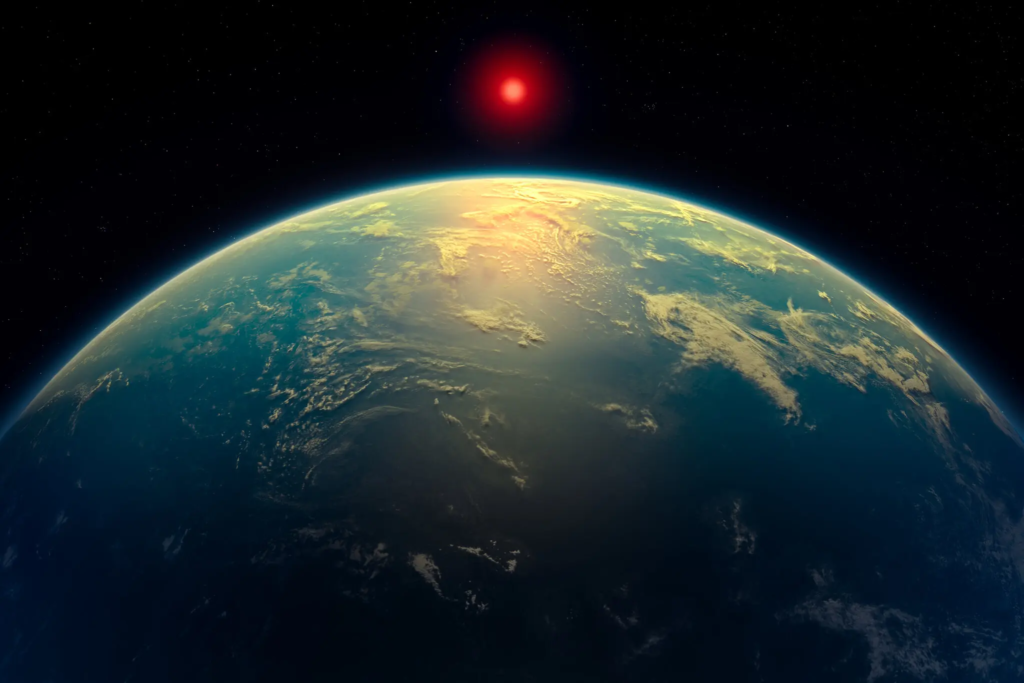
The discovery comes from a team of researchers led by Dr. Nikku Madhusudhan of the University of Cambridge, who analyzed data from NASA’s James Webb Space Telescope. Their findings suggest that K2-18b, a type of planet known as a Hycean world, may have a warm ocean beneath a hydrogen-rich atmosphere—and most intriguingly, it appears to contain dimethyl sulfide (DMS), a molecule that on Earth is only produced by living organisms such as marine algae.
“This is a revolutionary moment,” said Dr. Madhusudhan. “It’s the first time humanity has seen potential biosignatures on a habitable planet.”

What Makes This Discovery Special?
K2-18b belongs to a class of exoplanets called sub-Neptunes—worlds larger than Earth but smaller than Neptune, with no direct counterpart in our own solar system. In 2021, Dr. Madhusudhan’s team proposed the term “Hycean” to describe planets that may be covered by oceans and have hydrogen-based atmospheres—prime candidates in the search for alien life.
With the powerful infrared sensors of the James Webb Space Telescope, the researchers studied light filtering through K2-18b’s atmosphere as it passed in front of its star. That light revealed molecular signatures—hydrogen, methane, carbon dioxide—and notably, dimethyl sulfide.
This compound is key. On Earth, it’s solely produced by living organisms. Its presence, if confirmed, could be one of the strongest hints yet that K2-18b may host life.
“We spent a long time trying to eliminate the signal,” Dr. Madhusudhan said. “But the evidence for dimethyl sulfide stayed strong.”
Caution and Skepticism in the Scientific Community
Despite the excitement, scientists are approaching the discovery with cautious optimism. The presence of dimethyl sulfide alone doesn’t confirm life, and alternative explanations remain possible.
“It’s a hint, not a confirmation,” said Dr. Stephen Schmidt of Johns Hopkins University.
Some researchers suggest that K2-18b might not be a habitable ocean world at all. A separate study from the Southwest Research Institute argues that it could be a molten rock planet with a thick, scorching hydrogen atmosphere—conditions hostile to life as we know it.
Moreover, scientists emphasize the need for further laboratory testing to understand how dimethyl sulfide behaves in alien environments, and whether it could be produced through non-biological processes on such planets.
“We’re only just beginning to understand these exotic worlds,” said Dr. Matthew Nixon from the University of Maryland.
What’s Next?
More observations from the Webb telescope are on the way, and NASA is developing even more advanced space telescopes designed to look for signs of habitability on distant worlds like K2-18b.
Still, researchers warn that identifying definitive proof of life could take years, if not decades.
“Unless we see E.T. waving at us, we won’t get a smoking gun,” said planetary scientist Dr. Christopher Glein.
There’s also concern about future funding. Proposed budget cuts to NASA’s science division could jeopardize follow-up missions and delay the search for life elsewhere in the cosmos.
“If those cuts go through,” said astrobiologist Dr. Joshua Krissansen-Totton, “the search for life would basically stop.”
For now, the discovery of dimethyl sulfide on K2-18b is one of the most tantalizing signs yet in humanity’s ongoing search for extraterrestrial life—a step that could bring us closer to answering the age-old question: Are we alone in the universe?